 简体中文
简体中文 English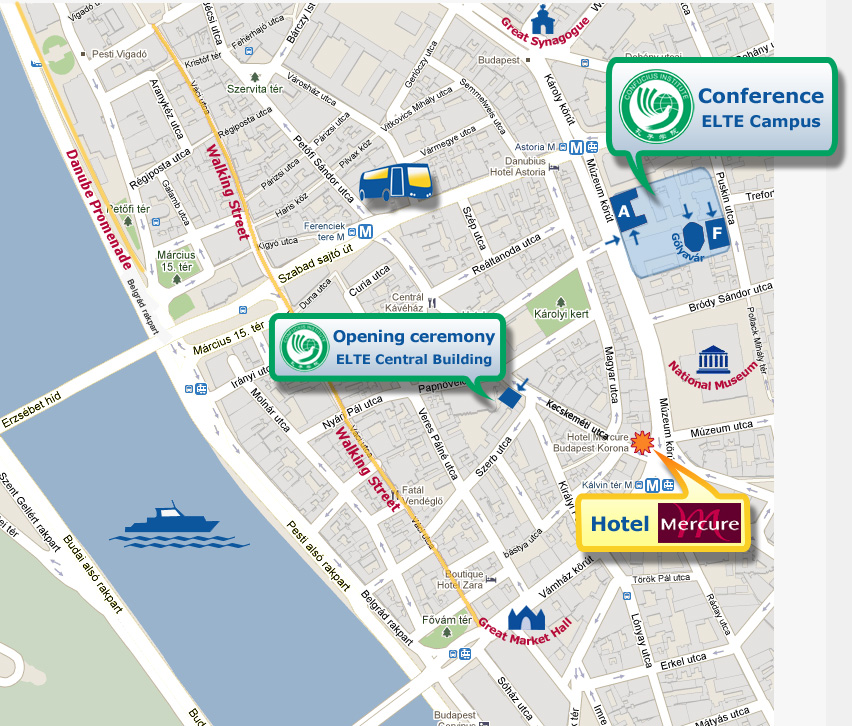
Hotel information
The 4 star Mercure Budapest Korona hotel is located in the heart of the city. The hotel offers a wide range of services for leisure and business travelers alike: free WiFi, pool, sauna, Internet corner, upgraded Privilege room, 2 restaurants, lobby bar, garage and souvenir shop. 421 rooms in two buildings make it possible to select various features when booking.

Distances from the hotel
ELTE Central Offices (2 minutes)
ELTE Campus (6 minutes)
National Museum (2 minutes)
Pedestrian Area (Vaci street) and Danube (5 minutes)
Great Market Hall (5 minutes)
Great Synagogue (8 minutes)
Public transport
There is a metro station on nearby Kálvin Square (on the blue line) and stops for the no. 47 and 49 trams and the no. 15 bus
ELTE
ELTE (short for Eötvös Loránd University) is the oldest and largest institute of higher education in Hungary. It has a history of over 376 years, having been established in 1635.

Faculty of Humanities
The Faculty of Humanities of ELTE is the largest university faculty in Hungary, and has served as a centre of Hungarian culture for centuries. Its present campus, built in the 1880’s, is located in the centre of Budapest, a few minutes’ walk from two subway stations, the National Museum, The Great Synagogue and a number of other attractions.
ELTE Confucius Institute
ELTE Confucius Institute (ECI) ECI is located in the historical heart of Budapest, capital of Hungary, on the campus of the Faculty of Humanities of ELTE. ECI is the first and only Confucius Institute in Hungary. It was established in 2006, with the cooperation of ELTE and Beijing Foreign Studies University. Since its establishment five years ago, ELTE Confucius Institute has become the most important centre for Chinese language and culture in Hungary.
It won the Outstanding Confucius Institute Award in 2007.
History of ELTE
The foundation of today's ELTE University of Budapest, Hungary, took place in Nagyszombat in 1635, and was the work of Cardinal Péter Pázmány (1570-1637), the Archbishop of Esztergom.
By founding the university, Pázmány established an institution which was eventually to play a far greater role in the history of Hungarian education and culture than he could have imagined.
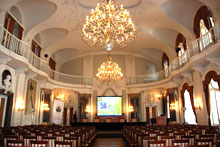 At the time of its foundation the university had only two faculties: those of Arts and of Theology. There were almost one thousand students attending the university and the secondary school classes in 1637; there were also foreign students right from the start.
In 1667, the university was expanded through the establishment of the Faculty of Law, and in 1769, by the addition of the Faculty of Medicine. Another very important stage in the history of the university came in 1777 when it was moved into the newly-rebuilt Royal Palace in Buda. The Ratio Educationis, published by Maria Teresa in 1777, which regulated the whole Hungarian educational system, gave paramount importance to Eötvös Loránd University, since the government regarded it – the only Hungarian university until the University of Kolozsvár was founded in 1872 – as the most important academic institution in the country.
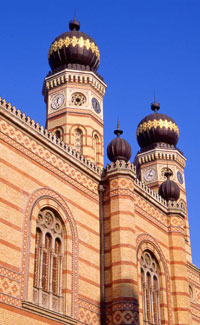 The synagogue on Dohany street in Pest is not only the most impressive one in the country, but the largest synagogue of Europe and the second largest in the world. (The largest Jewish house of worship in the world is the Emanu-El Temple in New York).
The walks in the Jewish Quarter of Budapest all have their departure point at the Dohany Synagogue. This magnificent, recently restored twin-towered building will soon be celebrating its 150th anniversary. Let it take your breath away with its beautiful interior; you will see why it is among the top ten sights of Budapest.
The Museum
At no. 2 Dohany street, right next to the synagogue, there once stood a two-storey house in Classicist. Style, where Theodor Herzl (1860-1904), the founder of Zionism, was born and raised. The Jewish Museum was built on the plot where the house used to stand, adjoining the Dohany synagogue. The little square in front of the Dohany complex is named after Herzl. The Jewish Museum, which was built in 1930-1931, has a very rich collection of religious relics of the Pest Hevrah Kaddishah, ritual objects of the Sabbath and the High Holidays, a Holocaust room and a historical exhibition, and also houses temporary exhibitions (including, works by Chagall, Soutine, Modigliani and many others).
www.greatsynagogue.hu
The Hungarian National Museum is the most important and one of the oldest collections in Hungary. As the first museum in the country, it was founded by a highly educated peer, count Ferenc Széchenyi, in 1802, who offered his collection of manuscripts, maps, coins and prints as the core material for a national museum. The Museum was designed by Mihály Polláck, one of Hungary's best-known architects of the period between 1837 and 1847. The monumental neoclassical building was opened in 1847, when it was the fourth largest museum in Europe.

Permanent exhibitions:
• The Hungarian Holy Crown and the Hungarian Coronation Jewels
• The history of the peoples of Hungary from the prehistoric ages until their arrival in Transylvania (896 A.D.)
• The history of the peoples of Hungary from 896 until 1848.
www.hnm.hu
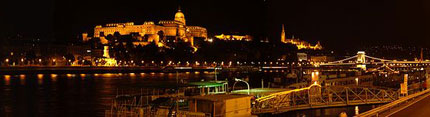
"Lights of the City" - June 17.
A short guided tour by bus to see the most magnificent views of Budapest by night.
Date: June 17, Departure at 21:00, Arrival: 22:30.
Duration: 1.5 hours. By bus with some walking.
Price: 25 EUR /pax.

City tour of Budapest - June 18
A two-hour guided tour, viewing the monuments of Budapest in detail.
Date: June 18, Departure at 15:00, Arrival: 17:00.
Duration: 2 hours.
By bus and on foot.
Price: 25 EUR /pax.
"Danube River Cruise" - June 18.
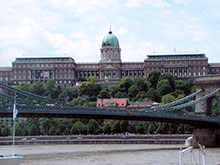 A one-hour guided cruise along the "Blue Danube" to see the finest parts of the city.
Departure at 13:00, Arrival: 15:00 (including transportation to pier by bus).
Duration of cruise: 1 hour. Total length of tour (bus + boat): 2 hours.
Price: 25 EUR /pax.
Shopping and sightseeing
Visit the Great Market Hall at the Pest end of Liberty Bridge to combine shopping with sightseeing. The three-storey hall offers plenty to do and see for at least 1-2 hours. The Market’s sheer size and splendor makes it one of Budapest's top attractions.

History
Construction of the Great Market Hall started in 1894 following the plans of Samu Petz. In 1896, a few days before the inauguration was due, a fire destroyed about half of the roof. After repairs had been effected the market opened on 15th March 1897, together with the other four Budapest Markets, built at the same time. The Great Market Hall was reconstructed between 1991 and 94. Beautiful Zsolnay tiles cover the vast roof structure, making it the most spectacular element of the building viewed from outside.
Most modern indoor markets
Budapest's Great Market Hall was one of the most modern indoor markets of its time, with up-to-date lighting and refrigeration. Originally stall-holders brought their products into the hall through a network of underground canals, but these are no longer in use.

Váci Street
Váci utca (Váci street), one of the main pedestrian thoroughfares, is perhaps the most famous street in central Budapest.
It is one of the main shopping streets in Budapest, with many restaurants and shops catering primarily to the tourist market.
As Lonely Planet says "It's tourist central, but the line of cafés and shops are worth seeing — at least once."
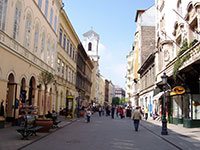 Váci Street is 1.2 km long; the first section running from Fővám Square to the Elizabeth Bridge (650 m), while the second leads from the Elizabeth Bridge to Vörösmarty Square (550m). The street opens onto Vörösmarty Square, the real centre of the city, where the traditional Gerbeaud coffee house has long been a great spot for watching people.
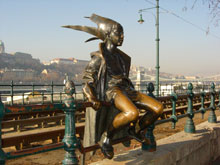 The Danube Promenade extends from the Erzsébet Bridge to the Chain Bridge; highlights include:
Március 15 Square, where the remains of a Roman fort named Contra-Aquincum were discovered. Contra-Aquincum, built in the second century AD, was an important part of the defensive system of the Pannonian province.
Vigadó Square; half-way along the promenade is the eccentric Neo-Byzantine Vigadó Concert Hall. There is a fine view across the river to Buda Castle, Matthias Church and the Fishermen's Bastion
The Chain Bridge (Hungarian: Lánchíd) is a suspension bridge that spans the River Danube between Buda and Pest, the western and eastern halves of Budapest. Two famous buildings, the Hungarian Academy of Sciences and the Gresham Palace, line the square on the Pest side of the Bridge.